A philosophical worldview or belief system grounded on the 20th century discovery that Information, rather than Matter, is the fundamental substance of everything in the universe. It is intended to be the 21st century successor to the ancient worldviews of Materialism and Idealism. An Update from Bronze Age to Information Age. It's also a Theory – of – Everything that covers, not just matter & energy, but also Life & Mind & Love.
10. EnFormAction : Abbreviation of Energy + Form + Actualization. It’s Ententional Causation. A proposed metaphysical law of the universe that causes random interactions between forces and particles to produce novel & stable arrangements of matter & energy. It’s the creative force (aka : Divine Will) of the axiomatic eternal deity that, for unknown reasons, programmed a Singularity to suddenly burst into our reality from an infinite source of possibility. AKA : The creative power of Evolution; the power to enform; Logos; Change. https://blog-glossary.enformationism.info/page8.html
Metaphorically, EnFormAction is the Will-power of the Creator or Programmer, and is the First Cause of everything in creation and the ensuing evolutionary program. So EFA is the general causal agent of everything in the world. Energy, Matter, Gravity, Life, Mind are specific & secondary creative causes, each with limited application. All are also forms of Information, the "difference that makes a difference". EFA works by directing causation from negative to positive, cold to hot, ignorance to knowledge. Such relationships are the basis of mathematical ratios and logical reasoning [A : B :: C : D]. By interpreting those associations & proportions we get meaning and reasons.
The concept of a river of causation running through the world in diverse streams has been variously interpreted in scientific terms as Momentum, Impetus, Force, Energy, etc, and in metaphysical idioms as Will, Love, Conatus, and so forth. EnFormAction is all of those. Like a burst of Energy, the universe began with all the Potential Information it would ever have : the Program. But its physical forms can be rearranged in almost infinite patterns. Constant change requires flexible adaptation. Hence, our world is not Deterministic, but Opportunistic.
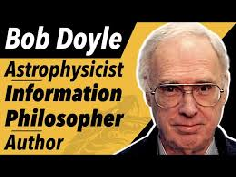
The worldview of Materialism¹³ assumes that physical substance is not only eternal, but carries within the mysterious power to diversify, and to eventually become mindful. Yet it also accepts the “law” of thermodynamics that every organism, including the Cosmos, will eventually end in a spasm of Heat Death, when all free energy is locked-up in inert Entropy. Yet, “Information philosophy offers a much more optimistic view, one that supports the view of a providential universe. Our "ergodic"¹¹ information-creating processes are the source of everything of value in the universe”. That term, “providential”, could mean simply favorable conditions for Life & Mind. Or it could mean : divine foresight & intervention. Personally, I prefer the former inference, since I have no direct communication with divinity.
Quantum physicist “Wheeler was one of the first prominent physicists to propose that reality might not be wholly physical; in some sense, our cosmos must be a “participatory” phenomenon requiring the act of observation--and thus consciousness itself”. His “It from Bit”¹⁴ hypothesis combined the New Physics with Computer concepts to suggest that physical science must be compatible with metaphysical Information in order to understand how & why the world works as it does. “I do take 100 percent seriously the idea that the world is a figment of the imagin-ation.”¹² That commonsense-defying notion seems to have influenced the Information Philosopher, and also the BothAnd philosopher.
— End of Post 148 —
Information is the creative power to transform : Causation
13. Materialism : “Materialist meta-physicians hold that the fundamental nature of underlying reality is matter, which is partly correct. They think that all mental phenomena, e.g., consciousness, can be explained as material interactions. This is incorrect.
We must also investigate the arrangement and organization of matter (in short, its information), and we must investigate the communications between material things (the communication of immaterial information, inside living things and between living things).” https://www.informationphilosopher.com/knowledge/materialism.html
14. It from Bit hypothesis “John Wheeler proposed a deep relationship between immaterial information and material entropy that he calls "It from Bit." He thinks the "Its" of actual information structures emerge from the "Bits" of possible new information”. https://www.informationphilosopher.com/
Information Philosophy (I-Phi) is a new philosophical method grounded in science, especially modern physics, biology, psychology, neuro-science, and the science of information. Information philo-sophy offers novel solutions to classical problems in philo-sophy, notably freedom of the will, the objective foundation of values, and the problem of knowledge (epistemology). Insights into human freedom and cosmic values could form the basis for a new system of belief and a guide to moral conduct.
Cosmic Creation : Energy + Information
“In a single decade of the mid-twentieth century, the word information was transformed from a synonym for knowledge into a mathematical, physical, and biological quantity that can be measured and studied scientifically.“
“Information philosophy is an idealistic philosophy, a process philosophy, and a systematic philosophy, the first in many decades. It provides important new insights into the Kantian transcendental problems of epistemology, ethics, freedom of the will, god, and immortality, as well as the mind-body problem, consciousness, and the problem of evil.”
"A difference that makes a difference" is a phrase coined by anthropologist Gregory Bateson defining information as a "bit" of news of difference that creates a meaningful impact, change, or distinction in a system.





 BACK
NEXT
BACK
NEXT
 Forum
Forum