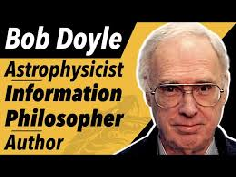
A philosophical worldview or belief system grounded on the 20th century discovery that Information, rather than Matter, is the fundamental substance of everything in the universe. It is intended to be the 21st century successor to the ancient worldviews of Materialism and Idealism. An Update from Bronze Age to Information Age. It's also a Theory – of – Everything that covers, not just matter & energy, but also Life & Mind & Love.
Post 151.March 10, 2026
The Information Philosopher
Cosmic Creation Process
Bob Doyle began as an astrophysicist at Harvard, but later branched-off into audio & video engineering, and once financially secure, began to call himself The Information Philosopher (TIP). That’s because, based on Quantum Physics and Information Theory, he came to believe that Information is the fundamental element of our physical & mental reality. He claims to have read “more works of philosophers and scientists than any other modern thinker”. His website¹ offers plenty of evidence to support that assertion. While developing my own personal information-based philosophy, I relied on his site for a lot of scientific & philosophical references.
One of Bob’s somewhat radical postulates is “the cosmic creation process (CCP) that appears to violate the second law of thermodynamics”. For example, the Big Bang’s initial state of low Entropy (high energy) was left unexplained by the cosmologists. So, since Big Bang physics left some key philosophical questions hanging, he began to look for alternative theories. An influential book was David Layzer's book Cosmogenesis:The Growth of Order in the Universe. Doyle was also influenced by Erwin Schrö-dinger’s 1944 article "What Is Life?". From which, he proposed Schrödinger's Rule: No Growth Without A Negentropy Source. And in my own thesis, Negentropy is labeled as Enformy².
In his introduction to CCP³, he claims that Information Philosophy answers the most fundamental question in ontology : what exists and how did it come into existence? His answer is : One Potential, many forms of Information⁴. So, evolution is the process of creating new Real Things from Ideal Forms. According to the ancient Greek philosopher, Plato, Forms (abstract Patterns, unrealized Designs, archetypes) are immaterial, perfect, and un-changing concepts or models that exist in a non-physical, trans-cendent realm, representing the true essence of things. Physical objects in our world are merely imperfect, transitory copies or "participants" in these paradigms, which are considered the ultimate reality and the Ontological source. For my own purposes, I think of the realm of Ideal Forms simply as the not-yet-real Potential for Actualization. So the process of in-form-action is what we today call Causation, and its agent is physical Energy.
Therefore, you could say that 14Billion years of processing has produced (actualized from potential) the physical (and mental) Cosmos⁵ we now inhabit. Obviously, this is a much slower, and less magical, act of creation than the fiat lux of Genesis. Conse-quently, the CCP has more to do with Physics than with Religion. And Information Philosophy has more to do with here & now existence than eternal life elsewhere. Doyle says, “Information is the modern spirit, the ghost in the machine, the mind in the body. It is the soul, and when we die, it is our information that perishes. The matter remains”.
1. Information Philosopher “I’ve spent the last twenty-five years building this website using a web publish-ing system of my own design that preserves every draft of every page (following a suggestion in 1999 by Tim Berners-Lee), . . .” https://www.informationphilosopher.com/
2. Enformy : In the Enformationism thesis, Enformy is a hypo-thetical, holistic, meta-physical, natural trend or force, that counteracts Entropy & Randomness to produce complexity & progress.
Information is the creative power to transform : Causation
4. In-Form-Action : “According to the Information Philosopher, information is a physically embodied, measurable quantity that constitutes the meaningful structure of the universe. It is "in-form-action", defined as the "difference that makes a difference". Information is considered immaterial—existing as relationships and arrangements—yet it requires a material carrier to be stored or communi-cated”. https://www.informationphilosopher.com/
5. Cosmos : “Carl Sagan defined the Cosmos as "all that is or was or ever will be," emphasizing it as an orderly, interconnected, and awe-inspiring system. It represents the totality of existence, including space, time, and all natural laws, with humanity acting as a way for the universe to know itself.” https://www.google.com/search?q=sagan+cosmos+definition&client=firefox-
Post 151 Continued . . . click Next
Holistic & Complex Systems The new properties that appear during a phase transition (e.g., the rigidity of ice versus liquid water's fluidity) are examples of emergence, where the collective behavior of a large number of particles results in system-level properties that individual particles do not possess. This concept is a fundamental aspect of complexity theory, which is mathematically compatible with a materialist and deterministic framework.
Complexity theory contrasts with determinism by showing that some complex systems can have emergent properties that are not reducible to the deterministic rules of their components, and these systems may not be predictable even if they are technically deterministic.. Determinism posits that all events are predetermined by prior causes, while complexity theory suggests that phenomena like consciousness and free will could emerge in complex systems where order and randomness interact
Information Philosophy (I-Phi) is a new philosophical method grounded in science, especially modern physics, biology, psychology, neuro-science, and the science of information. Information philo-sophy offers novel solutions to classical problems in philo-sophy, notably freedom of the will, the objective foundation of values, and the problem of knowledge (epistemology). Insights into human freedom and cosmic values could form the basis for a new system of belief and a guide to moral conduct.
What is Information? As an English verb, Information is the power to inform, to convey meaning & ideas. As a noun, it refers to facts, data, knowledge, or instructions. But for the purposes of philosophy, its implications are broader and more metaphysical : spirit, energy, causation, intelligence
Cosmic Creation
“Sadly, cosmic creation is horrendously wasteful. In the existential balance between the forces of destruction and the forces of creation, there is no contest. The dark side is overwhelming. By quantitative physical measures of matter and energy content, there is far more chaos than cosmos in our universe. But it is the cosmos that we prize, the information that we value. ” https://www.informationphilosopher.com/introduction/creation/


 BACK
NEXT
BACK
NEXT
 Forum
Forum