A philosophical worldview or belief system grounded on the 20th century discovery that Information, rather than Matter, is the fundamental substance of everything in the universe. It is intended to be the 21st century successor to the ancient worldviews of Materialism and Idealism. An Update from Bronze Age to Information Age. It's also a Theory – of – Everything that covers, not just matter & energy, but also Life & Mind & Love.
Popular books on Emergence Theory John Holland's Emergence: From Chaos to Order Steven Johnson's Emergence: The Connected Lives of Ants, Brains, Cities, and Software, Harold J. Morowitz's The Emergence of Everything: How the World Became Complex.
Post 148.December 19, 2018 updated & revised 11/27/2025
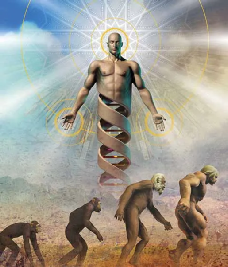
Emergent Evolution
Emergence, Phase Transitions, & Quantum Leaps
The improbable appearance of Life and Mind from inorganic processes over the past 13.8 billion years is one of the most astonishing facts of nature. This gradual development of higher-order phenomena/qualia from lower-level processes has puzzled scientists and philosophers for centuries. Also physical Phase Transitions¹ — like water changing from solid to liquid to gas — are empirically mysterious. These incremental transformations challenged 17th century deterministic, mater-ialistic models, because the properties of each phase were different, and couldn’t be predicted from the previous state.
Consequently, in the early 19th century, philosopher-scientists began exploring the concept of Emergence². They observed that higher phases of matter exhibit properties that are not reducible to the attributes of lower phases. These sometimes instantaneous transformations resembled quantum leaps, where electrons jump between energy states without passing through intermediate stages. Chaotic systems add another layer of complexity. Despite their unpredictability, stable patterns and self-organized structures often emerge from apparent randomness. Nature seems to conceal its complexity behind curtains of noise, making it difficult for scientists to decode using linear logic, and traditional reductive methods.
Therefore, faced with such complications, and provided with quantum tools, some 20th century scientists began to develop a formal theory of Emergence². The primary defining charac-teristic of emergent states of matter was that the properties of higher phases were impossible to predict from those of the lower phases. It was as-if matter on a macro scale made a quantum leap from one energy state to another, just like electrons jumping from orbit to orbit around an atom without passing through any of the intermediate possible states : like going from 5 to 10 without passing through 6-7-8-9. In a deterministic materialistic worldview, this just does not compute.
Meanwhile, the obstacle of mechanically unpredictable behavior was causing problems in other macro scale material phenomena. For example, within the random interactions of Chaotic Systems, stable form-patterns, feedback loops, and fractal self-similarities appear out of nowhere as-if self-organized. These novel states of matter can, in principle, be traced back to initial conditions of the Big Bang, yet again the intermediate steps are blurred by randomness. So, the scientific community had to admit that thoseobserved stable states seemed to emerge from nowhere, for no reason.
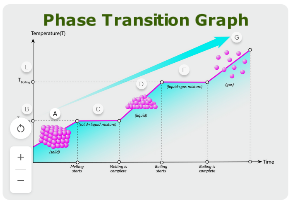
1. Phase Transitions : Matter normally exists in stable forms, called “states” that are unchanging patterns of atomic structure.
In the Phase Transition graph, below center, the combination of 2 hydrogen molecules and one oxgen molecule exists in the form of liquid water at environ-mental temperatures that are compatible with living organisms. But as the energy level goes up or down, the water-of-life becomes harmful to Life, as the atomic patterns transform from loosely connected fluids to inter-connected solids or to independent parts.
Note :
The horizontal lines between phases indicate where the “magic” happens, and scientists can’t distinguish between the components of the systems, until they settle-down into a new comformation.
Evolution
Phases & Stages
2. Emergence : Emergent philosophy, or emergentism, is the position that complex systems have novel, irreducible properties that arise from the inter-actions of their simpler com-ponents, but cannot be predicted or fully explained by studying the com-ponents in isolation. It offers a middle ground between reductionism (that everything is reducible to its parts) and dualism (that there are separate physical and non-physical sub-stances). Examples include life emerging from non-living molecules, consciousness arising from neurons, or wetness from water molecules. https://www.google.com/search?client=firefox-b-1-d&q=emergent+philosophy
The formal term "emergence" was introduced in the 19th century, and the concept flourished with the British emergentists in the late 19th and early 20th centuries, who debated how higher-level phenomena like life and mind could arise from physical matter. The modern study of emergence continues today, examining how complexity and organization arise in every-thing from physics to biology to social systems.
Post 148 Continued . . . click Next
Holistic & Complex Systems The new properties that appear during a phase transition (e.g., the rigidity of ice versus liquid water's fluidity) are examples of emergence, where the collective behavior of a large number of particles results in system-level properties that individual particles do not possess. This concept is a fundamental aspect of complexity theory, which is mathematically compatible with a materialist and deterministic framework.
Complexity theory contrasts with determinism by showing that some complex systems can have emergent properties that are not reducible to the deterministic rules of their components, and these systems may not be predictable even if they are technically deterministic.. Determinism posits that all events are predetermined by prior causes, while complexity theory suggests that phenomena like consciousness and free will could emerge in complex systems where order and randomness interact




 BACK
NEXT
BACK
NEXT
 Forum
Forum